
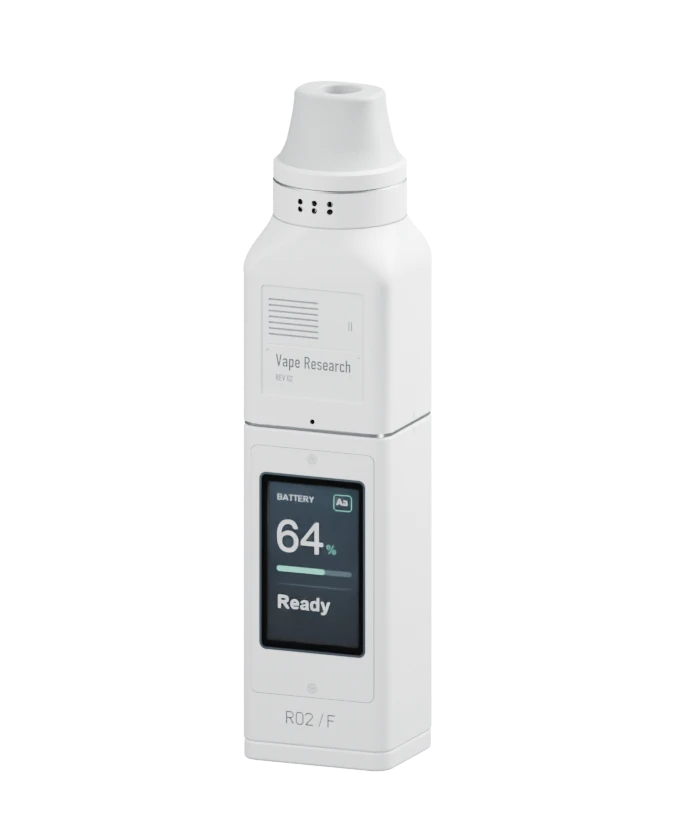
Our ambition is to develop the first healthy vaping solution. We want an adult who already vapes to be able to pick up a reusable device, take a draw, and get the familiar sensation and nicotine effect while avoiding as much harm as possible. That ambition shapes every choice, from the ingredients in the refill bottle to the last seal before the mouthpiece.
Whether a nicotine vape can earn the word “healthy” is the central research question. Nicotine itself is addictive. We can measure what leaves the device, study how it affects people and report what the evidence supports. A claim to be first would also need a documented comparison with existing products. Both health and novelty remain unproven. Health Canada’s overview of vaping risks
Health takes priority in design decisions
Start each choice with the harm it could prevent and the harm it could introduce. Before comparing candidates, record the alternative, what will be measured, the use conditions and what result would change the decision. Check performance after wear and repeated refills as well as when new. If a familiar sensation or a premium finish introduces an avoidable hazard, revise that feature. If the evidence cannot distinguish two options on health grounds, keep the uncertainty visible and make the remaining choice on usability, durability or appearance.
Apply this rule to the current cylinder. Evaluate the round reservoir against a vented reference for oxygen ingress, degradation, leakage and reliable liquid feed. Evaluate the outer shape separately by comparing a round shell with a flat-sided shell around the same internal air path. Check grip, accidental inlet blockage, rolling and leakage after a drop. Until measurements support a preference, the modeled exterior is provisional.
Development budget and premium pricing
The project has no preset development budget, unit-cost ceiling or target retail price. The commercial intent is a premium product whose price reflects the fabrication and quality-control costs required by the proven design. Establish those costs from the manufacturing process, supplier quotes, expected production volume, yield and inspection requirements once the design is sufficiently defined.
Agents should keep a technically promising option under consideration even when it requires custom tooling, specialist materials, multiple prototype rounds or independent laboratory testing. Rank candidates first by evidence about exposure and failure risks throughout the product’s life. Compare nicotine delivery and the intended sensation within those constraints. Document the cost of each meaningful improvement and the failure it addresses. For example, if a custom refill valve costs more to manufacture, measure whether it limits air entry and leakage after repeated refills while maintaining liquid flow. Where two designs perform equally well, the simpler assembly is a reasonable choice.
Budget flexibility makes difficult experiments possible. Their results determine which claims the product can support. Treat the premium price as a commercial decision, and evaluate health effects and any claim of being first on their own evidence.
Premium display and user controls
Evaluate a small status display against an indicator-only device. Give adults legible charge, service and fault information and allow adjustments to brightness, text size and timeout. A fault lockout must operate independently of the display. Sensor failure, a blank screen or an acknowledged warning cannot grant permission to heat. Compare comprehension, sealing, impact resistance, energy consumption and heat before selecting hardware. The display fit study compares a larger colour IPS LCD in the flat grip with a monochrome OLED in the round housing, with individually inspectable layers and simulated readouts. Review the flat housing mechanical checks and round housing checks before changing the housing or electrical layout. Electrical operation and physical sealing remain unverified.
Record every product decision and significant revision in the website’s design record, with its purpose, alternatives, evidence and outstanding tests.
Why nicotine is required
The finished product must contain nicotine. Its stimulant effect is part of the experience we want to preserve for adults who already vape. In controlled studies, nicotine briefly improved performance on some attention tasks. Other tasks showed no improvement or poorer performance. For a person who uses nicotine regularly, relief from withdrawal can also contribute to feeling more focused. These findings do not establish a lasting health benefit from vaping. Controlled attention study · Alertness and withdrawal study
We want the device to cause as little harm as possible. Nicotine itself can cause dependence and temporarily raise heart rate and blood pressure. Purifying the liquid or preventing oxidation cannot remove those effects. Agents should measure how consistently the device delivers nicotine, look for unexpectedly high delivery during repeated use, and assess avoidable exposures from the carrier, flavour and hardware. Any claim of improvement must identify what improved, by how much and compared with which device. Health Canada
What the experience should feel like
Think of one puff. How hard do you have to draw? How warm does it feel? What do you feel in your throat? How quickly do you feel the nicotine? These are the details we want to preserve. We’ll choose an existing vape as a reference so “the same sensation” has a clear meaning.
Apple ice is our example flavour. It has two parts to evaluate: the taste of apple and the cooling sensation. We don’t yet have a formula shown to be safe to inhale. An ingredient that is safe to eat can behave differently when heated and breathed in. We’ll start with an unflavoured comparison so we can tell what changes when flavour or cooling is added. Québec currently restricts retail sales of vaping products with flavours other than tobacco, which matters if we plan to sell there. Health Canada · Québec’s rules
What we’re designing
- The liquid. We need to know what goes into it, how it changes in storage, and what ends up in the mist a person inhales. Testing the ingredients alone cannot answer all three questions.
- The container and refill system. Air can change the liquid over time through a process called oxidation. We want to limit that change from the first fill to the last draw. The refill bottle, tank, seals and connections all count. As the tank empties, it must keep supplying liquid reliably without leaking. We’ll compare reservoir designs before choosing one.
- The reusable device. The body should last through many refills. The design must account for cleaning, worn parts, battery protection and what happens when the liquid runs low. A nearly empty tank is especially important because an uneven supply of liquid can let the heater overheat.
- Every physical part in Blender. The editable model will include the mouthpiece, air path, tank, seals, refill connection, mist-producing assembly, battery, electronics, enclosure and fasteners. An exploded view will show how the parts fit together. A cutaway will show where air and liquid travel.
How we’ll know whether it works
We need two results. First, once the device is ready for an appropriately reviewed user study, adults who already vape should judge its draw, warmth, throat sensation, flavour and nicotine effect against the reference vape. Second, independent lab tests should show lower emissions of specific harmful substances at comparable nicotine delivery. That comparison matters because a weaker puff could look cleaner simply by delivering less of everything.
The lab should test fresh liquid, stored liquid and liquid from a repeatedly refilled device, including near the end of a tank. It should measure the nicotine delivered and check the mist for metals, substances released by seals or other parts, and chemicals formed during heating. A lower result for one substance is meaningful only if we also look for problems introduced elsewhere. Even good results would support a specific claim about measured emissions. Long-term health effects would remain a separate question.
Who needs to contribute
These responsibilities describe the expertise the project needs. One person may cover several areas. Agents can research, model, compare and document. Physical measurements need a competent laboratory, clinical judgments need qualified clinicians, and each specialist should be able to challenge a decision made in another discipline.
| Expertise | Question this person owns | What they contribute |
|---|---|---|
| Formulation and analytical chemistry | What goes into the refill, what changes during storage, and what reaches the mouthpiece? | Ingredient and impurity records, stability studies, methods for identifying and measuring known and unexpected compounds |
| Packaging and materials science | What passes through a wall, escapes a seal, sticks to a surface or migrates into liquid? | A map of contact materials, barrier and compatibility tests, comparison of finished reservoir assemblies |
| Mechanical engineering | Can the device refill, feed, seal, survive a drop and come apart for service throughout its intended life? | Mechanism comparisons, tolerances, assembly drawings, failure analysis and service-life tests |
| Physics and aerosol science | Where do air, liquid, heat and droplets go during and between draws? | Flow and heat models with stated assumptions, measured pressure drop, particle sizes, liquid delivery and temperatures |
| Electrical, battery and controls engineering | How does the device behave if liquid runs low, a sensor fails or charging goes wrong? | Power and protection design, fault response, charger compatibility and independent checks of shutdown behaviour |
| Inhalation toxicology and exposure science | Which exposures matter at the measured amounts and frequency? | Prioritized substances and biological endpoints, interpretation of mixtures, uncertainties and reasons to stop or investigate |
| Microbiology and hygiene | What can enter during refill or cleaning, survive storage, or collect in a damp mouthpiece? | Sampling of liquid and reusable parts, validation of cleaning and drying, criteria for safe service intervals |
| Clinical pharmacology, addiction medicine and human factors | What does comparable nicotine delivery mean for an adult using the device? Can they refill and use it as intended? | Clinical interpretation of dose and dependence, usability studies, sensory comparisons and ethical oversight for any human research |
| Metrology and statistics | Can we distinguish a real improvement from a change in sampling or chance variation? | Sampling plan, calibrated measurements, detection limits, uncertainty estimates and rules for interpreting conflicting results |
| Industrial design, Blender and manufacturing quality | Does each modeled part correspond to something that can be made, assembled, inspected and replaced? | Editable models, parts register, assembly sequence, production variation and traceability |
| Regulatory affairs and public health | Which requirements and claims apply in the intended market, and who else could be exposed? | Dated jurisdiction review, assessment of foreseeable youth access and bystander exposure, evidence review for proposed claims |
How agents should make decisions
- Start with a question that could change the design. “Does this seal admit less oxygen after fifty refill cycles?” is answerable. The cycle count in that example is illustrative. Derive actual test durations from the proposed service life.
- Follow the material or energy across an interface. For each part, identify what touches either side, what can cross it, what moves, what heats up and what happens after the user puts the device down. Include stored liquid, replacement air, condensate, saliva, charge current and waste where relevant.
- Identify the evidence behind each statement. Record whether it is a user requirement, published finding, supplier statement, model prediction or observation from this exact revision. State the conditions under which a published result was obtained. A result from a cell culture, a particular device or a different formulation has a limited scope.
- Propose a comparison that could prove the idea wrong. Name the reference, hold the other important variables steady, identify a credible alternative explanation and record what result would make us change course. Include an adverse outcome the proposed improvement could create.
- Consider the adult’s whole use pattern. Report output per draw, per session and per amount of nicotine delivered when meaningful. Ask what happens if the person takes longer or more frequent draws to get the same sensation. Treat that behaviour as a question until measured.
- Keep uncertainty visible. Record the measurement range, instrument uncertainty, units tested and unexplained findings. “Below detection” means the method could not reliably detect the substance at that level. A single favourable prototype is weak evidence about a production run.
- Leave a decision another agent can reopen. Record the chosen option, alternatives, evidence, unresolved risks, responsible discipline and next decision. Identify which earlier results expire when a supplier, seal, formulation, heater, control algorithm or cleaning procedure changes.
For example, a collapsible reservoir may reduce replacement air entering the liquid compartment. A fold near the outlet could also interrupt liquid delivery. The packaging specialist tests oxygen ingress, the mechanical engineer measures flow as the reservoir empties, and the chemist tests emissions during the interruption. A design decision needs all three results. Lower oxidation combined with higher heat-generated emissions would require a redesign or a different reservoir.
Follow the contents from manufacture to inhalation
| Stage | What the team must consider | How to investigate |
|---|---|---|
| Ingredients arrive | Identity and purity of nicotine, carrier, flavour and cooling agent; contaminants, supplier variation and storage history | Record supplier, lot, specifications and analytical results. Verify critical ingredients independently. Require the composition behind a flavour name. |
| Ingredients are combined | Solubility, separation, concentration uniformity, acidity, viscosity and reactions between ingredients | Compare fresh samples from different parts of a batch. Track physical changes and compounds formed after mixing. A substance suitable for eating needs separate evidence for inhalation. |
| Refill bottle is stored or opened | Dissolved oxygen, air above the liquid, light, moisture exchange, temperature, evaporation, age and repeated openings | Compare sealed and opened bottles from the same lot over time. Measure nicotine and breakdown products. Use light and temperature controls to distinguish causes. |
| Liquid moves into the device | Bubbles, spillage, contamination, incompatible refills, residual old liquid and accidental skin or oral exposure | Observe representative refill cycles with a suitable test fluid. Evaluate connector wear, wrong connections, cleaning and child access. Recheck chemical findings with the actual formulation in the lab. |
| Liquid sits in a used device | Heat from charging or use, contact with seals and metals, backflow, concentrated residues and damp pockets | Compare stored liquid with matched reference samples. Test assembled contact surfaces after use and cleaning. Investigate newly detected substances before assigning their source. |
| The device produces aerosol | Uneven liquid supply, hot spots, heat-generated chemicals, particles shed from parts, large droplets or liquid reaching the mouth | Collect both gases and droplets as appropriate. Compare cold starts, repeated draws, partial blockage, low fill and end-of-life parts. Report any leakage or shutdown. |
| Aerosol reaches people | Nicotine dose, particle sizes, gases, mouth and airway exposure, frequency of use and exhaled emissions | Distinguish emissions at the mouthpiece, estimated exposure and actual absorbed dose. Document changes from evaporation or humidity during measurement. Measure bystander exposure separately if making claims about it. |
Some flavour compounds can react with a carrier during storage. Heating can generate additional compounds. Aerosol droplets can change size in a humid airway. Each calls for a different measurement. Even perfect oxygen isolation would leave these questions open. Flavour–carrier reaction study · Heating study · Artificial-lung study
Engineer the container and its interfaces
Treat the refill bottle, cap, transfer connector, reservoir, closure and liquid outlet as one assembly. For each interface, draw the liquid path, replacement-air path and likely leak path. Include the position of the device when upright, on its side, inverted and carried in a pocket.
- Air and pressure. A rigid tank needs a way to accommodate liquid leaving. Compare a vented reference with a collapsible pouch and a moving piston or diaphragm. Test oxygen entry and delivery near empty. The pouch adds folds and seams. A piston adds friction and a moving seal. Keep all concepts provisional until tested.
- Chemical compatibility. Record exact grades of plastics, elastomers, metals, coatings, adhesives and lubricants, plus residues from manufacture. Ask what the liquid might extract and what a surface might absorb from the liquid. Check swelling, cracking, corrosion, loose particles and change in seal force. Test materials with each candidate formula.
- Protection during storage and transport. Consider sunlight, heat, cold, temperature cycling, pressure changes, vibration and drops. A liquid-tight closure can still admit gas over time. Test the assembled package for both leakage and oxygen ingress, including after a drop or repeated refill.
- Cleaning and service. Map where liquid, condensate, saliva or cleaning fluid can collect. Identify which surfaces the user can reach and dry, which parts need replacement and what prevents incorrect reassembly. Verify performance after cleaning and reassembly.
- Containment after a fault. Trace where liquid goes if the primary seal fails. Examine routes to the mouthpiece, skin, battery and charging port. Investigate accidental activation, blocked vents, damaged seals and use after a fall. Define how the user recognizes a fault and how the device enters a safe state.
Packaging guidance for medicines provides a useful way to ask about protection, compatibility and performance of the finished assembly. Applicable legal requirements for this project require their own market-specific review. FDA container-closure guidance · Health Canada product safety
Premium mechanical design of the container
Premium is a product requirement. An adult should be able to hold the device comfortably, align the refill by touch, recognize when the closure is seated, and put the device away with a clean exterior. After months of use, the closure should still engage consistently and worn service parts should be replaceable without damaging the housing. These are proposed acceptance goals. The mechanical lead owns them from concept through production inspection.
| Assembly | Mechanical work | Evidence before committing to the design |
|---|---|---|
| Reservoir and supports | Draw the surfaces that locate and support the filled reservoir. Trace where grip pressure, insertion force and drop loads travel. Provide room for thermal expansion, manufacturing variation and any intended motion of the reservoir wall. | Sectioned assembly and tolerance analysis at both extremes of fit. Test full and nearly empty assemblies after drops and temperature changes for leakage, oxygen ingress and uninterrupted feed. |
| Refill connector and closure | Guide the connector into alignment before the seal engages. Define the seating stop, seal compression, retention and release. Examine a partly inserted connector and the order in which flow opens and closes during coupling. | Measure engagement and release forces and any escaped liquid across repeated cycles. A partially seated connection must be distinguishable from a closed one. Check that tactile feedback still corresponds to a sealed connection after wear. |
| Outer housing and finish | Define grip shape, balance when full and empty, edge radii, seam alignment, surface texture and finish boundaries. Keep decorative coatings away from fluid and inhaled-air paths unless qualified for those exposures. | Use physical handling samples to assess grip and operation with dry and damp hands. Inspect gaps, flushness, finish wear, loose movement and rattle before and after handling and cleaning tests. |
| Service interface | Identify the parts an owner removes, the parts reserved for service and how seals are inspected or replaced. Make incorrect orientation or incomplete assembly apparent. | Reassemble worn and new parts across different production samples. Repeat containment and feed checks after service and verify that protection against unintended opening is retained. |
Required engineering package. Alongside the editable Blender assembly, deliver dimensioned mechanical drawings or parametric CAD for critical interfaces, a parts and materials register, tolerance calculations, assembly and service instructions, and an inspection plan. Identify the reference surfaces from which dimensions are measured. Specify how manufacturing will check seal seats, closure travel and mating surfaces that are inaccessible after assembly.
How to set premium targets. Benchmark several physical closure and finish samples. Record which users can operate the mechanism comfortably, the force and travel they experience, and whether they can reliably identify a complete closure. Use those findings and the sealing tests to set numerical targets and allowable variation. Record the proposed material, finish process, supplier capability and test method together. Material, styling, numerical tolerances and service life remain open until the team has evidence to choose them.
Preserve the experience without hiding a tradeoff
Use an identified reference device and record its fill, age, settings and condition. Measure the effort needed to draw air at several flow rates, the delay before aerosol appears, mouthpiece temperature and variability of nicotine output. Record perceived warmth, throat sensation, apple taste, cooling intensity and duration separately. A stronger cooling sensation could change perceived harshness while chemical emissions remain the same. Sensory ratings alone cannot answer a toxicology question. A laboratory airway-tissue study of WS-23 illustrates why cooling agents need their own evaluation. WS-23 study
Compare an unflavoured baseline, the apple component, the cooling component and their combination in bench studies where justified. This can help locate a change that only appears when ingredients are combined. Keep sensory preferences open until adult participants can assess them under an appropriately reviewed protocol. Clinical specialists must evaluate any claim about speed of nicotine absorption. A machine can measure nicotine leaving the mouthpiece but cannot measure how quickly a person feels it.
Build a Blender model that engineers can use
Create separate, named, editable parts for the refill and device assemblies. Include closure, seals, valve, reservoir, liquid feed, atomizer, airflow passage, mouthpiece, condensate handling, enclosure, cell, protection electronics, sensors, charge port, insulation, retainers and fasteners as applicable to each concept. Include purchased assemblies in the parts register and state where internal geometry is simplified or unavailable.
Provide assembled, exploded and sectional views. Make it possible to trace liquid, air, condensate and heat across a section and to inspect seal placement and service access. Record units, revision, part function, material candidates, mating surfaces, contact with liquid or inhaled air, and whether dimensions were assumed, specified or measured. Check fit, clearance, assembly order and access for removal. Model competing reservoir concepts before fixing production dimensions. Capture unresolved tolerance, thermal and material questions alongside the relevant part. A visually accurate model establishes geometry only to the accuracy of its inputs.
Evidence needed for each development decision
| Decision | Evidence to collect | What would hold the decision open |
|---|---|---|
| Choose a reservoir concept | Matched liquid in each candidate and a sealed reference. Compare oxygen ingress, leakage, flow, wear and chemical migration after simulated use. | A concept preserves liquid better but starves the atomizer, leaks or introduces an unexplained compound. |
| Choose a formulation for further research | Ingredient identity, aged and fresh chemistry, stability, aerosol composition and inhalation-toxicology review for the intended exposure. | A meaningful unidentified peak, unexplained dose drift, or insufficient toxicological evidence for an additive. |
| Advance the integrated device | Repeated tests across units and lots, including fresh and worn parts, charging, low fill, drops, blockage and sensor faults. | A protection depends on a sensor whose failure disables that same protection, or results vary beyond justified limits. |
| Evaluate the experience in people | Independent safety and ethical review, adult participant criteria, defined endpoints and a way to record and respond to adverse effects. | Bench evidence or oversight is insufficient to justify human exposure. |
| Describe a benefit publicly | A claim linked to a specific comparator, outcome, device revision, study population and duration, with applicable regulatory review. | Only bench emissions have been measured and the proposed wording promises a clinical benefit. |
Before collecting data, specify which outcomes matter, how many units and batches are needed, how limits were chosen and how uncertainty will be handled. Use blanks to identify contamination from the test equipment. Use a reference liquid and repeated measurements to detect drift. Record sampling losses, calibration, detection limits and the gas or particle fraction each method captures. Retain raw results, failed runs and reasons for excluding data. Confirm unexpected findings with an independent method where feasible. Manufacturing variability warrants testing multiple units even when their drawings are identical. Study of 75 nominally identical devices
Separate the two clocks in this project. Shelf life asks how long an unopened refill stays within justified limits. In-use life asks what happens after opening, partial depletion, refill, cleaning and wear. Establish both with real-time evidence. Accelerated ageing can screen candidates, but its relevance depends on whether the same failure mechanisms occur in ordinary use.
Specialist specifications for the first comparison
These specifications come from AI agents reviewing the brief from distinct technical perspectives. They define proposed work for qualified specialists and laboratories. No formula, production material, exposure limit or operating setting has been selected.
Formulation chemistry
Create a controlled ingredient register for each candidate liquid. Record the identity, function, grade, concentration basis, batch tolerance and impurity profile of every component. Record nicotine’s chemical form and express total nicotine consistently as nicotine-base equivalent so quantities can be compared across formulations. Obtain the composition of the apple and cooling blends, including their carriers and minor constituents, under confidentiality if necessary. Leave an undisclosed blend open for assessment.
Divide one liquid lot among a characterized reference container, the refill bottle and the assembled reservoir. Track sample mass, water content, nicotine, representative flavour compounds and new chemical signals at filling, after storage and after simulated use. Compare the baseline, apple alone, cooling alone and their combination, including after ageing. Loss of an apple compound could reflect evaporation, absorption into a seal or a reaction. Investigate where it went before assigning a cause. Primary flavour chemistry study
Postgraduate analytical chemistry
Before the first comparison, register the named analytes, reference device, draw conditions, acceptable difference in nicotine delivery, minimum meaningful reduction and statistical confidence required. Have the laboratory and toxicologist justify the margins. Report absolute amounts per draw and session alongside amounts per unit of emitted nicotine. Increasing nicotine output could improve the ratio even if emissions of a harmful substance stayed constant.
Qualify the entire measurement path. Check for gases escaping through collectors, droplets settling in tubing and chemical changes between collection and analysis. Record the recovery and reporting limit for each analyte in each relevant sample type. Track liquid consumed, material collected at the mouthpiece and residue retained in the device. Report the unexplained fraction. If both candidate and reference are below the quantitation limit, report the bounds and leave the reduction unresolved. ICH analytical validation guidance
Randomize run order and distinguish separate devices and production lots from repeated draws on one unit. Record test day, component lot and formulation lot. Preserve individual excursions as well as averages. Investigate reproducible new signals with the toxicologist and report identification confidence, estimated amount and transfer into the aerosol.
Mechanical engineering and transient heat transfer
Require an integrated refill-to-near-empty test for each reservoir candidate. Time-align reservoir pressure, mass loss, heater temperature, electrical current, shutdown events and aerosol samples collected around identified events. Document sensor response times and collection delays. If a sampling interval spans several events, record that limitation before attributing a chemical signal to a particular event. A short interruption in liquid feed could disappear in an average across a session. Local heater conditions can affect carbonyl emissions. Heater study
| Engineering deliverable | Decision it supports |
|---|---|
| Pressure and flow diagram from refill bottle through reservoir outlet, checked on a bench fixture at full and low fill, upright and inverted, with fresh and aged parts | Determine whether each design can feed reliably throughout its proposed operating range. |
| Fault records for partial blockage, low fill, failed sensor and restart, including peak temperature after shutdown | Compare detection time and residual heating with an independently justified fault limit. Redesign if shutdown occurs too late. |
| Connector travel diagram with measured seal engagement, valve opening, valve closing, disengagement and tactile cue | Quantify false indications of closure and escaped liquid by mass during partial insertion, withdrawal, side loading and wear. |
| Load-path drawings and post-impact inspections of the enclosure, reservoir, cell and connector | Examine a dropped, partly filled assembly before subsequent refill or controlled charging tests. Check electrical isolation, leakage, retention and flow. |
| Tolerance analysis and interchangeable parts from independent lots, including replacement seals | Identify the combinations with the least seal compression, highest insertion force and smallest feed margin. Test those combinations again after servicing. |
Inhalation toxicology and exposure assessment
For each priority substance, estimate a plausible range of daily exposure under typical and frequent use. State the assumptions connecting machine emissions to inhaled and deposited dose. Identify whether the toxicological reference value applies to repeated inhalation, the organ at risk and the duration under study. Assess mixtures that affect the same organ. Record each newly detected substance and each increase individually. A decrease elsewhere cannot resolve the uncertainty around a new exposure.
For fresh, aged and near-empty units, pair mouthpiece chemistry with measurements of the dose reaching an airway tissue model. Compare repeated exposures with clean air, the unflavoured baseline and the reference device. Include controls that demonstrate the assay can detect a meaningful change. Evaluate the airway barrier, movement of the cilia that clear mucus, and recovery after exposure. The toxicologist should define decision criteria in advance. Hold advancement to human evaluation if the delivered dose is uncertain, the analytical method cannot resolve a concerning exposure, or a reproducible adverse response occurs at a plausible exposure. A favourable result supports the next investigation. Airway microtissue study
The first joint decision is whether a candidate merits further development after a change in chemistry or feed behaviour. The mechanical lead identifies the event, the analytical chemist establishes whether emissions changed, the formulation chemist investigates the source, and the toxicologist judges the consequence. If the team cannot connect those observations with adequate time resolution or sensitivity, record the decision as open and identify the measurement needed to resolve it.
What an agent must hand back
For each proposed change, deliver a short decision record with the question, affected parts and liquid, expected benefit, credible failure modes, comparator, evidence, uncertainty and next decision. Link the exact model revision, part or ingredient lot, test method and raw results where available. Mark a task as proposed, modeled, bench-tested, independently confirmed or clinically evaluated according to the work actually completed.
Keep a shared register of unresolved hazards. Each entry needs a cause, route of exposure or injury, affected person, preventive control, verification method, remaining uncertainty and responsible discipline. Include the person refilling or cleaning the device, children encountering spilled or discarded liquid, and people nearby during use. At end of life, account for residual nicotine, spent contact parts, battery removal and disposal. Claims about reduced waste require a comparison over the same period of use.
Where things stand
The project is at the research and design stage. We have a scientific feasibility review and reservoir requirements. The reference vape, liquid formula, reservoir design and materials are still open. The first editable Blender assembly now includes the device, refill container and competing reservoir concepts. The mechanical interfaces are provisional. Physical prototypes, supplier qualification and experimental results remain outstanding.
Exterior finish and housing comparison
Develop the satin-white, flat-front housing alongside the original graphite cylinder. Preserve the circular reservoir and piston interface, keep the finish external, and compare the two body profiles for grip, display readability, sealing and service access. Use matched body shapes when comparing finish temperatures. Measure solar reflectance, touch temperature and cell temperature before attributing a thermal benefit to the white finish. The Charles Jackson cube supplies the visual reference for the fine surface grain, seams and edge highlights. Qualify the physical substrate and finish on samples.
The white study pairs a softly flattened mouthpiece exterior with the existing circular passage. Compare it to the round tip in unpowered handling trials. Keep exterior etching clear of the mouthpiece, air inlet and seals. On the status screen, make the current condition or charge reading legible on the actual pixel grid, then check the assembled unit under glare, at an angle and in low light.
Tropical humidity and cold transitions
Treat sustained humidity, splashing, a cold device entering warm humid air, and a leak from the reservoir as distinct exposures. Moisture can form on internal surfaces even after the outside has dried. Prevent water from reaching the electronics, keep intentional air paths functional, and evaluate emergency cell venting separately. Examine the display window, base joint, fasteners, connector, reservoir bulkhead and vent interfaces after drops, cleaning and repeated service.
Specify separate limits for operation, charging and storage after choosing the cell and qualifying the assembled device. Measure cell and board temperatures and moisture where faults are consequential. Cold cells can suffer lithium plating during charging. The concept should default to heating and charging inhibited when temperature or moisture status is invalid. Re-enable only after verified recovery, with hysteresis to prevent rapid cycling. A display acknowledgement, timeout or dry exterior cannot clear the interlock. Do not use the aerosol heater to dry or warm the device.
Test transitions in a climate chamber with instrumented, initially unpowered samples. Include repeated temperature cycles, condensing and non-condensing humidity, sweat residues, gasket compression set, blocked openings, temperature sensor faults and a partially filled reservoir at different orientations. Collect dry-bay moisture, leakage current, corrosion, fault response, seal leakage and liquid carryover data. Establish acceptance criteria and an operating envelope from physical evidence. Environmental design record
Touch controls
Study a transparent capacitive sensor on the inner face of the flat display window with a dedicated controller and sensor flex. Separate LCD data, touch input and electrical safety decisions. Prioritize legible status, one large target and read-only diagnostics. Validate false touches under moisture, sweat, cleaning, gloves and charger noise. A gesture, acknowledgement or processor reset must never clear a hardware inhibit. Touch electronics and validation