
Research date: 25 November 2026. Initial evidence review, not an exhaustive systematic review or a product safety certification. Domain research deferred at Charles's request. Working project identity retained.
Finding
A reusable device with lower measured emissions is a plausible research objective. A harmless nicotine vape, especially a flavoured one used repeatedly for years, is not established by current evidence. No apple-ice formulation can presently be certified safe from this review. “Healthy” must remain an aspiration, not a substantiated product claim.
Vapes normally produce an aerosol of droplets and gases, not combustion smoke or simply water vapour. Liquid purity alone cannot establish aerosol safety: heating, storage, device materials, dose and use patterns all matter. Health Canada overview
Why the controversy exists
The comparison changes the answer. For adults who smoke, complete substitution reduces exposure to many combustion toxicants. For someone who does not smoke, vaping introduces avoidable exposure and dependence. Population policy also weighs adult cessation against youth initiation. These are different questions. National Academies consensus
The August 2026 Cochrane update finds high-certainty evidence that nicotine e-cigarettes improve smoking quit rates compared with nicotine replacement therapy. This establishes cessation benefit in the studied populations, not lifelong inhalation safety or the safety of a new formulation. Longer and larger studies remain necessary for safety assessment. Cochrane update, review
Sources of harm and implications
| Source | Evidence and limitation | Design implication — proposed, unvalidated |
|---|---|---|
| Nicotine | Addictive; can acutely increase heart rate and blood pressure. Developmental and pregnancy risks also matter. It is not responsible for all smoking harm, but calling it a stimulant does not make it benign. Health Canada | Characterize delivered dose and variability; prevent leakage and accidental access. Synthetic nicotine and salts do not eliminate nicotine risks. |
| Carrier heating | Propylene glycol and glycerol can form toxic carbonyls. Laboratory degradation has also been observed below 200°C; no universal safe temperature follows from these studies. Primary study | Measure actual emissions throughout the operating envelope, including local overheating and low liquid. A temperature setting alone is insufficient. |
| Flavour chemistry | Some flavour aldehydes react with propylene glycol during storage, producing compounds with different toxicological properties. Food approval does not establish inhalation safety. Primary study | Require exact composition, impurities, stability and aerosol-specific toxicology for each ingredient and mixture. |
| Cooling additives | WS-23 caused adverse effects in laboratory airway microtissues. This is a hazard signal, not a measured human disease rate or proof every exposure produces injury. Primary study | Do not assume “ice” is an inert sensory effect. Leave cooling additives out of the initial research baseline. |
| Device materials | Aerosols can contain metals from the liquid or hardware; emissions depend on product and operation. National Academies | Test the entire wetted and air-contact pathway, including ageing, corrosion, seals and particles. Ceramic or mesh construction is not automatically safer. |
| Adulteration and contamination | Vitamin E acetate was strongly associated with EVALI, particularly in the illicit THC supply. This outbreak does not describe all nicotine vaping, and eliminating that additive does not eliminate all risk. Primary clinical investigation | Exclude vitamin E acetate; avoid oil-based additives and uncharacterized extracts. Establish batch purity, traceability and contamination controls. |
| Hardware and handling | Battery incidents and nicotine poisoning are separate from aerosol toxicity. Health Canada product safety | Protected power system, leakage resistance, child-resistant access and service-life testing. Waste reduction depends on service life and the parts discarded per refill. Respiratory safety requires separate evidence. |
Apple ice and alternative chemistry
“Apple ice” names a sensory profile, not a chemical specification. Its apple flavour may be a mixture, and its cooling sensation may come from menthol or synthetic coolants such as WS-23. A supplier's ingredient list and independent analysis would be necessary before assessing a particular product. Neither natural origin nor food grade establishes suitability for chronic inhalation.
Removing diacetyl, oils, colourants, sweeteners and unnecessary additives can remove particular hazards or uncertainties, but does not establish that the remaining aerosol is harmless. In particular, no claim that vaping routinely causes “popcorn lung” follows from diacetyl's known occupational hazard; Health Canada reports no confirmed Canadian cases resulting from vaping. Health Canada risks
Replacing PG/VG with water, saline or another solvent is a research hypothesis, not a ready safe solution. A nonthermal atomizer might avoid some heat-generated chemicals but would still deliver nicotine and droplets, with dose, deposition, contamination and materials questions. Water vapour and nebulized liquid are different exposures. No mixing recipe or human-use prototype is validated here.
If avoiding lung exposure is the overriding requirement, non-inhaled nicotine delivery deserves comparison. It changes the product concept and does not remove dependence, but avoids delivering a flavour/carrier aerosol into the lungs.
Proposed development sequence
- Define intended adult users, comparator, exposure duration and target market. Separate reduced-emission endpoints from clinical harm claims.
- Establish an unflavoured laboratory baseline before introducing apple or cooling chemistry. This is an experimental control, not a safe consumer recipe.
- Engage an inhalation toxicologist, analytical laboratory and device engineer to set endpoints and justified acceptance criteria before testing.
- Measure nicotine delivery, carbonyls, volatile compounds, metals, particles and extractables/leachables; assess storage stability, microbiological contamination and batch variability. Test new and aged parts under realistic and foreseeable misuse conditions.
- Investigate airway-cell responses, including inflammation, barrier function and ciliary effects; recognize that negative cell tests cannot establish lifelong human safety. Human research requires appropriate ethical and regulatory review.
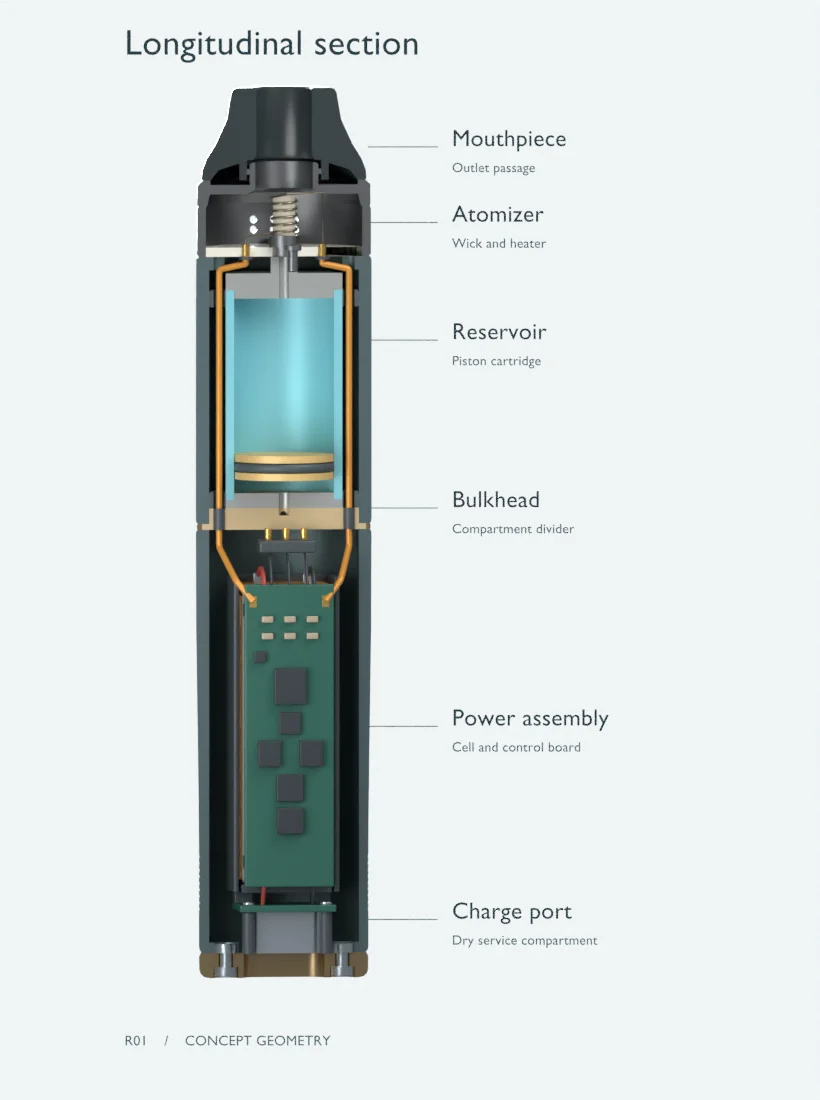
- Model the selected architecture in Blender with separate editable parts: enclosure, service closures, protected battery assembly, PCB and sensors, charging assembly, reservoir, seals, atomizer subassembly, airflow path, condensate control, mouthpiece and fasteners. Include assembled, exploded and sectional views and a parts register. Actual materials, tolerances and manufacture require engineering validation beyond a Blender render.
No Blender model, selected atomizer, validated bill of materials, formulation, physical tests or clinical evidence for this proposed device exists yet. The requested eventual scope remains a reusable device modelled part by part.
Québec constraint
Québec prohibits sales of vaping products with flavours or aromas other than tobacco; unflavoured products remain permitted, subject to other requirements. Apple ice is therefore not a viable ordinary Québec retail flavour under the rules checked today. This is a product-planning constraint, not a reason to abandon research into lower emissions. Québec government