
Mouthpiece filter
Can a film just before the mouthpiece reduce the metals a person inhales? We are comparing the open passage with two inserts made from the same 11 µm polycarbonate film. One lays the film flat. The other folds it 16 times to fit more surface inside the same body. Metal capture remains unmeasured.
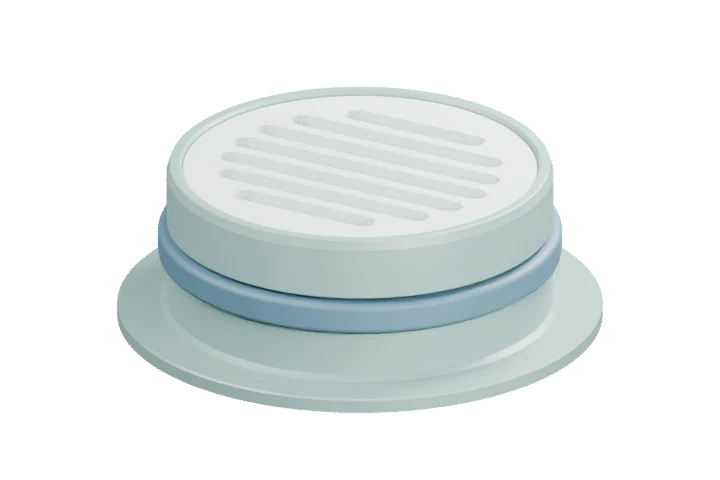
Flat filter cartridge
Assembled
Installed positions
Scroll to separate the parts, then follow each numbered marker.
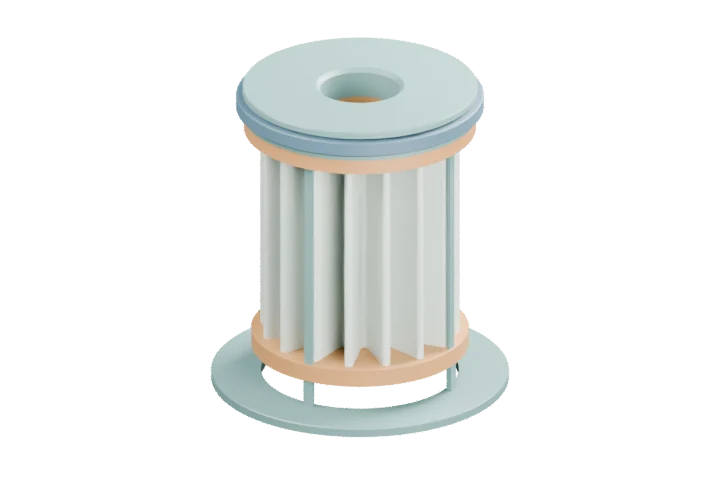
Pleated filter cartridge
Assembled
Installed positions
The film and its supports fit in the same mouthpiece. Scroll to separate the cartridge.
Design science
More accessible film area lowers the air speed through the membrane at a given draw rate. The disc’s inlet support exposes 10.75 mm². The pleat study leaves 257.53 mm² after deducting end seals, seam and support shadows. At 1 L/min, a calculation based on supplier dry-air data gives about 32 kPa across the disc film and 1.34 kPa across the pleated film. Both numbers exclude the rest of the flow path. Condensate can bridge adjacent folds or obstruct the small outlet.
What needs testing
First block the film and measure leakage around the seals and joints. Then compare open bore, flat disc and pleated insert on the same puff machine. Measure pressure throughout each draw, fresh and wet, alongside downstream metals, particle sizes, nicotine, flavour compounds and any shed material. Only physical testing can establish how much reaches the mouth or whether users perceive a difference in draw.
Flat insert parts
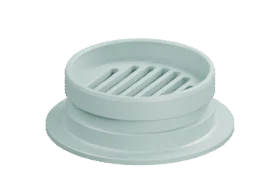 FLT-CARRIER
Inlet support and capture rim
The carrier has an integral ribbed inlet support beneath the film. Its perimeter land backs the film edge, while an external groove holds the bore seal.
The inlet ribs support the disc, and a continuous land backs the film where the edge gasket presses on it. A separate groove holds the seal against the mouthpiece bore.
Inspect part ↗ FLT-MEDIA
Track-etched polycarbonate film
An uncoated, PVP-free track-etched film sits between the inlet and outlet supports. The model uses 11 µm thickness within the supplier’s 10–12 µm range. The 1 µm nominal pores are below the scale of this view. Capture, taste and draw remain unmeasured.
A disc cut from the 11 µm modeled polycarbonate film spans the passage, giving the flat and pleated studies a common sheet material to compare.
Inspect part ↗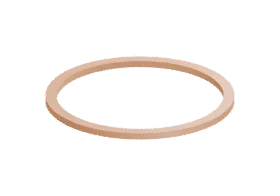 FLT-EDGE
Film-edge face gasket
The outlet support presses this annular gasket against the film perimeter on the carrier land. This is the barrier to flow around the film edge inside the cartridge.
The face gasket presses the edge of the disc onto a continuous backing surface. This joint addresses leakage around the film inside the cartridge.
Inspect part ↗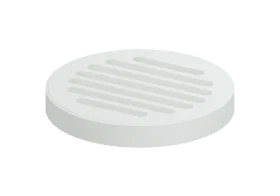 FLT-GRILLE
Outlet support grille
The outlet ribs support the mouth side of the film. Its perimeter loads the film-edge face gasket against the carrier land. Verify support, clamp load and wet retention on samples.
Crosswise outlet ribs limit film movement during a draw. An outer stop sets the edge-gasket gap, and a formed carrier lip retains the grille.
Inspect part ↗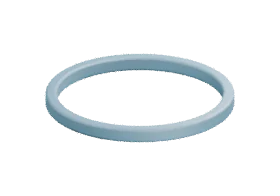 FLT-BORE
Cartridge bore seal
This radial seal contacts the mouthpiece bore and the carrier groove. Its purpose is to block flow around the outside of the cartridge. Actual leakage requires bench measurement.
The radial gasket spans the clearance between the cartridge and the existing mouthpiece bore. This addresses a separate bypass path outside the carrier.
Inspect part ↗
Pleated insert parts
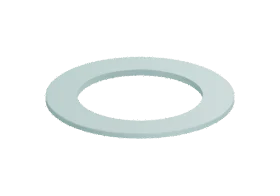 ALT-FLANGE
Captured inlet flange
Locates the cartridge on the existing chimney seat.
The flange sits on the existing chimney and is trapped beneath the mouthpiece shoulder, locating the taller pleated insert inside the original body.
Inspect part ↗ ALT-POST
Inlet plenum bridge posts
Keeps an inlet gap beneath the blind end so aerosol can turn outward.
Four posts raise the closed lower end above the inlet flange. The gap lets incoming aerosol turn outward toward the exposed pleats.
Inspect part ↗ ALT-BLIND
Blind potted inlet end
Closes the upstream end of the central passage and seals the lower film edge.
The lower end encloses the film edges and closes the entrance to the hollow core so incoming flow is directed toward the outside of the membrane.
Inspect part ↗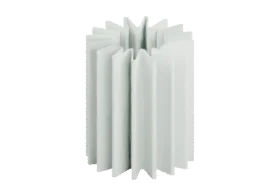 ALT-FILM
Rounded radial pleats · GVS 1224067
Provides the radial flow path through the folded polycarbonate sheet.
Sixteen radial folds place a larger sheet area inside the original bore. This could reduce dry film resistance, while liquid bridging adjacent folds could increase it.
Inspect part ↗ ALT-SEAM
Longitudinal overlap · sealing trial
Represents the proposed joint between the ends of the folded sheet.
Wrapping a sheet into a pleated sleeve brings its two ends together. The longitudinal overlap provides a joint to seal and test for leakage along its full length.
Inspect part ↗ ALT-GUARD
Four outer guard ribs
Limits outward movement of the folds.
Four narrow ribs bound outward movement of the folds while leaving channels for aerosol to travel along the outside of the cartridge.
Inspect part ↗ ALT-CORE
Four inner support ribs
Supports the inner folds around the central outlet.
The inner ribs provide support near the valleys of the pleats while leaving a central passage for aerosol that has crossed the film.
Inspect part ↗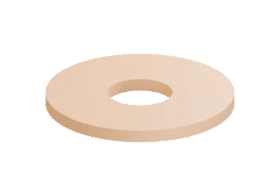 ALT-TOP
Annular potted outlet end
Closes the upper film edge while leaving the central exit open.
The annular upper end encloses the top edges of the folds while leaving the core open. Its joint separates the outer inlet channels from the outlet.
Inspect part ↗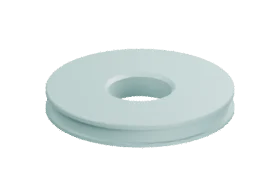 ALT-CAP
Outlet ferrule with gasket groove
Forms the outlet and holds the radial gasket in its groove.
The ferrule guides flow from the central passage into the mouthpiece and locates the outer gasket in a circumferential groove near the outlet.
Inspect part ↗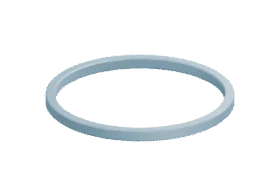 ALT-BORE
Radial bore gasket · compressed witness
Closes the route between the cartridge and the mouthpiece bore.
The radial gasket sits near the top of the cartridge to close the path from the outer inlet channel directly to the mouthpiece outlet.
Inspect part ↗