
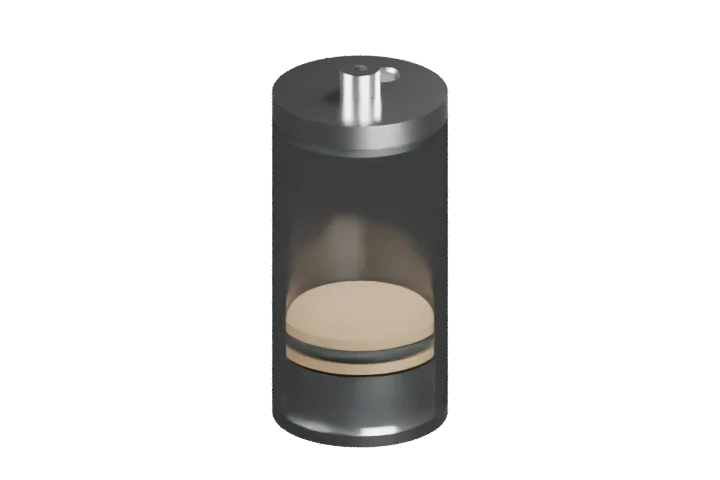
25 November 2026. Conceptual engineering assessment; no hardware or formulation validated. Supplements feasibility.en.md. Charles requires oxidation protection and assessment of every component, not only the liquid.
Governing requirement
Control oxygen exposure and chemical degradation throughout manufacture, storage, filling, use and reuse. Do not promise zero oxidation. Define allowable degradation products and nicotine-content drift through toxicological and analytical assessment before assigning shelf life. Nicotine assay or colour alone cannot establish safety. Air-exposure-related changes have been measured in e-liquids and aerosols. Primary study
Proposed architecture and tradeoffs
Evaluate a variable-volume reservoir isolated from the inhalation airflow, feeding a small atomization chamber through a controlled interface. This is a hypothesis for testing, not a selected production design. A rigid sealed tank develops reduced pressure as liquid leaves unless volume or pressure is compensated; a vent admits replacement gas. A collapsible reservoir or moving separator can provide compensation without deliberately admitting air into the liquid compartment, but neither guarantees an oxygen-free system.
Compare a barrier pouch (fold fatigue, seams, film permeation and leachables), a piston cartridge (seal leakage, friction, wear and lubricant compatibility), and a rigid reservoir as the experimental reference. No final material selection is justified yet. Minimize stagnant pockets, exposed surface and thermal coupling to the atomizer. Prevent contaminated condensate from returning to stored liquid. Account for temperature expansion, orientation, ambient-pressure changes and feed interruption.
Required controls and verification
| Issue | Proposed requirement | Evidence needed |
|---|---|---|
| Initial oxygen | Control dissolved oxygen and gas trapped during filling; assess controlled-atmosphere filling | Measured dissolved/headspace oxygen and subsequent degradation |
| Ingress | Evaluate walls, seams, closures, seals and feed/refill ports as one system | Whole-assembly oxygen ingress and leakage after ageing and handling |
| Refill | Assess closed transfer with self-sealing connections; retain a reusable body | Oxygen admission, trapped bubbles, contamination and seal wear over repeated cycles |
| Light and heat | Protective enclosure and thermal separation from power/heating components | Light exposure and measured reservoir temperature under use, charging and storage |
| Material interaction | Qualify all wetted parts, adhesives, coatings and process residues | Extractables, real-formulation leachables, sorption and compatibility over time |
| Feed reliability | Detect inadequate liquid delivery and stop atomization | Fault tests across orientation, fill level, viscosity and environmental conditions |
| Reuse | Define cleaning, drying and finite service life | Residue, contamination, seal integrity and performance after repeated servicing |
FDA drug-packaging guidance provides useful principles for protection, compatibility, safety and performance; it is not itself a declaration that this vape is a medicine or approved. FDA guidance
Chemistry and physics constraints
Do not add an antioxidant or oxygen scavenger to the inhaled formulation merely to improve storage stability: the additive and its reaction products introduce further inhalation questions. Oxygen control cannot prevent every flavour/carrier reaction or thermal degradation pathway. Packaging qualification must therefore include the aerosol generated from aged liquid, not only liquid analysis.
Heat flux and liquid supply both matter: local overheating can occur despite an acceptable nominal setting. Film-boiling research supports evaluating the heater/liquid interface rather than treating wattage as a safety guarantee. Primary study
Nonthermal atomization is a comparator worth investigating, not a proven safe alternative. It avoids intentional heater-driven vaporization but retains material, contamination, nicotine and aerosol-deposition questions. Droplets change in humid respiratory environments; initial size alone does not establish where exposure occurs. Artificial-lung study
The strongest alternative for avoiding lower-lung exposure is changing the delivery route. A documented medicinal oral-inhaler design delivers most nicotine to the mouth, with less than 5% of the released dose reaching the lower respiratory tract; its kinetics differ from smoking. That is a precedent, not proof for a new device or flavour. FDA 2024 Nicotrol label
Decision before detailed Blender modelling
Concept models of each reservoir can proceed now with provisional dimensions and materials. Use comparative tests to select a production architecture. Include the refill supply, as oxygen exposure before transfer also affects the liquid. Compare identical liquid lots in a sealed reference container and in each assembly. Test unopened, partly depleted and repeatedly refilled units, then assess emissions from the aged liquid against the same fresh-liquid baseline. Model the liquid, gas, airflow and thermal paths explicitly, including every seal and interface. Keep hypotheses, measured results and unresolved hazards separate. Blender can represent the assembly; it cannot certify permeation, chemical compatibility or respiratory safety.