
Reservoir
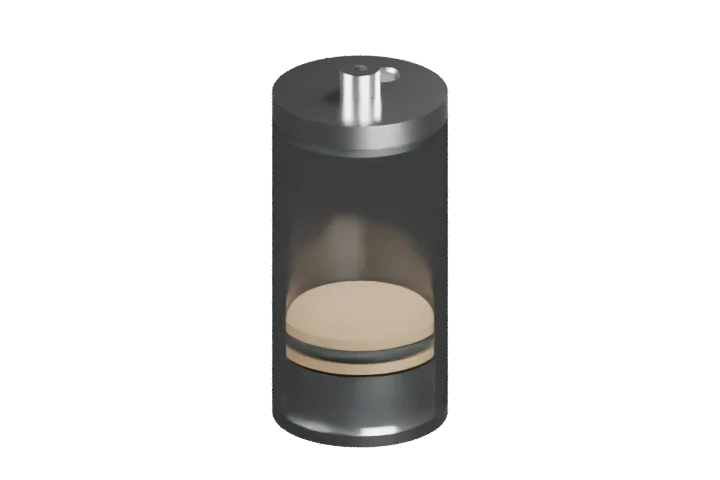
A moving piston follows the liquid as it leaves the cartridge. A vent admits air behind the piston, and a seal separates that dry space from the stored liquid. The front manifold carries two passages, one for filling through a self-sealing port and one for feeding the head.
Reservoir
Assembled
Installed positions
Scroll to separate the parts, then follow each numbered marker.
Design science
The moving piston compensates for the volume of liquid used. This gives the design a way to limit the fresh air that would otherwise enter a vented liquid space. Oxygen can still enter during filling or pass through seals and walls. The round bore gives the piston a continuous sealing surface. Its modeled 16.25 mm stroke sweeps 1.838 mL. Seal friction, air bubbles and trapped liquid affect usable capacity.
What needs testing
Measure dissolved and headspace oxygen immediately after filling and through storage and refill cycles. Track nicotine concentration and degradation products alongside seal wear, delivered volume and feed reliability. Compare the piston, vented rigid tank and collapsible liner under matched heat, light and orientation. Test refill pressure and overfill protection because the transfer device can displace several cartridge volumes.
Inner parts and interfaces
 F01
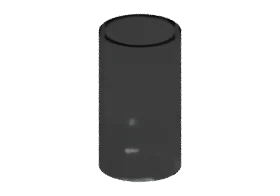
Precision barrel
Contains the primary liquid supply and guides the moving follower.
The circular inner wall serves as both the liquid container and the sliding seal surface. Its finish and roundness influence whether the piston moves smoothly and seals around its circumference.
Inspect part ↗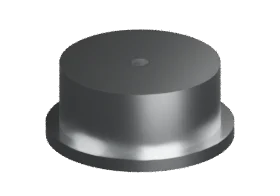 F02
Atmospheric end plate
Closes the rear of the cartridge while admitting air behind its follower.
A vent through the rear plug admits air behind the piston as liquid leaves. The plug also provides the rear stop that limits maximum piston travel.
Inspect part ↗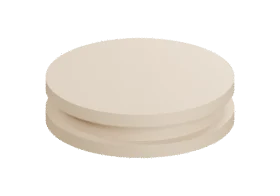 F03P
Primary reservoir follower piston
Moves as liquid leaves the cartridge, keeping replacement air on the dry side.
The piston moves toward the outlet as liquid is drawn from the cartridge. Its moving face allows the liquid chamber to shrink while the replacement air stays behind it.
Inspect part ↗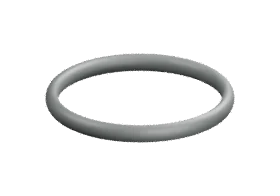 F03S
Primary reservoir installed piston seal
Fits around the moving cartridge piston to limit leakage and air bypass.
The seal travels with the piston and closes the clearance to the barrel. Its compression must limit air and liquid leakage without creating enough friction to interrupt the feed.
Inspect part ↗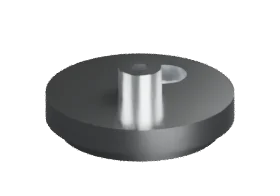 F04
Dual-port manifold
Routes incoming refill liquid and outgoing liquid to separate openings in the head of the cartridge.
The manifold keeps the outlet aligned with the head and places the refill opening off-centre so a transfer tip can engage it separately.
Inspect part ↗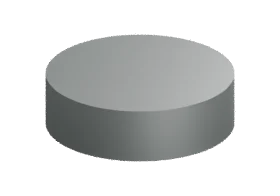 F05
Refill septum
Closes the refill opening and admits the transfer tip during refill.
The septum sits across the refill port so it can close after the blunt transfer tip is withdrawn. Recovery after puncture or repeated insertion needs testing on the intended slit and material.
Inspect part ↗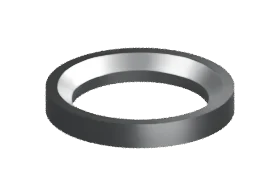 F06
Septum retaining bezel
Holds the refill septum in its seat.
The retaining bezel supports the septum during withdrawal and leaves a throat that guides the refill nose toward the centre of the seal.
Inspect part ↗